
RF Skin Needling vs Skin Needling: Which Treatment is Right for Your Skin?
You have probably noticed how quickly skin treatments have moved from simple facials to more advanced clinical options. It is no longer just about glowing skin for a few days. You are now choosing between treatments that actually remodel your skin from within.
Skin needling and RF skin needling are often mentioned together, sometimes even interchangeably. But they are not the same experience, and they do not work at the same depth. If you have been wondering why some people swear by one and others upgrade to the other, the difference is usually not hype. It is mechanism.
One works by creating controlled micro-injuries to trigger collagen. The other adds radiofrequency energy to heat deeper layers of your skin while those micro-channels are created. Same idea, very different intensity.
And here is the real question you should be asking yourself.
Do you want surface-level refinement, or are you ready to go deeper for more structural change in your skin?
That question is really where your decision starts. And before you can answer it properly, it helps to understand what each treatment is actually doing beneath the surface.
What Is Skin Needling?
Skin needling, also known as microneedling, is a minimally invasive treatment designed to support your skin’s natural repair process. Rather than introducing external substances, it works by encouraging your skin to regenerate from within.
A device fitted with very fine needles creates controlled micro-channels in the skin’s surface. These are not harmful wounds, but precise triggers that activate your body’s healing response.
Once this process begins, your skin increases the production of collagen and elastin. These are essential proteins that help maintain firmness, elasticity, and a smoother surface over time.
In practical terms, you are prompting your skin to repair itself in a more organised and accelerated way.
What Is RF Skin Needling?
If skin needling works by gently “waking up” your skin’s repair system, RF skin needling takes that same idea and turns up the intensity.
RF stands for radiofrequency. In this treatment, tiny needles are still used to create controlled micro-channels in your skin. But this time, those needles also deliver radiofrequency energy directly into the deeper layers of the skin.
This combination matters. You are not only triggering a healing response through micro-injury, you are also applying controlled heat where it counts most.
That heat reaches deeper structures in your skin, where collagen support is actually formed and maintained. The result is a stronger tightening and remodelling effect compared to traditional needling.
RF Skin Needling Vs Skin Needling: Key Differences
Now that you understand how both treatments work on their own, the difference becomes much clearer. It is not about one being good and the other being bad. It is about how deep you want the change to go and what your skin actually needs right now.
Both treatments rely on controlled micro-injuries to stimulate collagen. That is the shared foundation. But RF skin needling adds another layer of energy, which changes everything from depth to outcome.
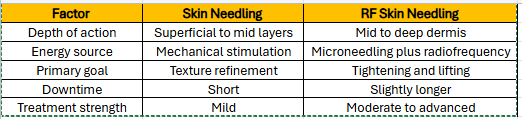
Let’s break it down in a way that is easy to compare.
Depth Of Treatment
Skin needling works at a superficial to mid-dermal level, focusing mainly on the upper layers of the skin where texture issues and early signs of ageing appear.
RF skin needling reaches deeper into the dermis, targeting the structural layers responsible for firmness and support.
This difference in depth is what sets the two treatments apart in terms of how transformative the results feel.
Technology Used
Skin needling relies on fine needles creating controlled micro-injuries to trigger a natural healing response.
RF skin needling combines the same microneedling action with radiofrequency energy, which delivers controlled heat into deeper skin layers.
The addition of heat in RF treatments enhances collagen remodelling beyond surface repair.
Treatment Outcomes
Skin needling primarily improves skin texture, tone, and mild scarring, making it suitable for early or mild concerns.
RF skin needling improves skin firmness, tightness, and deeper lines, while also addressing texture issues.
In simple terms, one focuses on refinement, while the other focuses on lifting and restructuring.
Downtime And Recovery
Skin needling typically results in mild redness and sensitivity that settles within 24 to 48 hours.
RF skin needling may involve slightly more visible redness and can take up to 2 to 3 days to fully calm, depending on intensity.
The deeper the treatment works, the more time your skin needs to recover and rebuild.
Treatment Intensity
Skin needling is generally considered a lower-intensity treatment, suitable for regular maintenance and early skin concerns.
RF skin needling is a higher-intensity treatment designed for more advanced concerns such as laxity and deeper structural changes.
This is why RF is often positioned as an upgraded or next-step option rather than a replacement.
Understand Why Skin Needling Works For You
Skin needling is not designed to deliver instant change. Instead, it works by activating your skin’s natural repair process in a controlled way. Over time, this helps your skin rebuild itself with improved quality and consistency.
Improve Skin Texture And Tone
One of the most noticeable benefits of skin needling is the gradual improvement in surface texture. As collagen production increases, your skin begins to feel smoother and look more even. This makes it particularly useful if you are dealing with roughness, uneven tone, or early textural concerns.
Reduce Mild Scarring And Pigmentation
Skin needling can also help soften the appearance of mild acne scars and superficial pigmentation. The improvement is gradual rather than immediate, but with repeated sessions, your skin starts to look more uniform and balanced.
Benefit From Minimal Downtime
Another advantage is how easily the treatment fits into your routine. Most people experience mild redness or sensitivity, which typically settles within 24 to 48 hours. This makes it a practical option if you want results without significant disruption to your daily schedule.
Choose A More Affordable Treatment Option
Skin needling is generally more accessible compared to advanced energy-based treatments. This makes it easier for you to commit to multiple sessions, which is often important for achieving consistent results over time.
Recognise Its Role In Your Routine
Overall, skin needling works best as a gradual improvement treatment rather than a corrective or high-intensity procedure. It is suited to you if your goal is steady refinement of texture and tone, rather than deeper lifting or structural change.
Understand The Benefits Of RF Skin Needling
RF skin needling is designed for when you want to go beyond surface refinement and target deeper structural changes in your skin. By combining microneedling with radiofrequency energy, it works at multiple levels to improve firmness, elasticity, and overall skin quality.
It is often chosen when skin concerns are more established and require stronger stimulation than traditional needling alone.
Strengthen Skin Firmness And Tightness
One of the key advantages of RF skin needling is its ability to improve skin laxity. The radiofrequency energy delivers controlled heat into the deeper layers of the skin, where collagen support structures are formed. This encourages firmer, tighter skin over time, especially in areas like the jawline, cheeks, and neck.
Improve Deeper Lines And Scarring
RF skin needling is more effective for concerns that sit below the surface. It helps soften deeper wrinkles and more pronounced acne scars by stimulating collagen remodelling at a structural level. The changes are gradual, but they tend to be more noticeable in terms of depth improvement compared to traditional needling.
Enhance Collagen Remodelling At A Deeper Level
Unlike surface-focused treatments, RF energy allows controlled heating within the dermis, which enhances how collagen is rebuilt and reorganised. This leads to longer-term improvements in skin strength and resilience, not just temporary surface smoothing.
Expect Slightly Longer Recovery Time
Because the treatment works deeper and uses energy-based technology, your skin may take a little longer to settle compared to standard needling. Mild redness and sensitivity are common for up to a few days, depending on intensity and skin response.
Choose Skin Needling If You Want Gentle, Gradual Improvement
Skin needling works best when your skin concerns are still mild and you are looking for steady refinement rather than dramatic change. It suits you if your focus is on improving surface quality while keeping the treatment simple and low intensity.
This is often the starting point for many people who are new to clinical skin treatments.
You may find skin needling more suitable if you are dealing with early signs of ageing, mild acne scarring, uneven texture, or general dullness. These concerns respond well to controlled stimulation of collagen at the surface level.
It also fits easily into your routine if you prefer minimal downtime and a treatment that does not require extended recovery. Your skin may feel slightly sensitive for a short period, but most normal activities can usually resume quickly.
Skin needling is also a practical choice if you want gradual improvement over time rather than immediate transformation. Results build with consistency, which makes it more of a maintenance-based approach to skin health.
In simple terms, you choose skin needling when you want refinement without intensity.
Choose RF Skin Needling If You Want Deeper Skin Transformation
RF skin needling is better suited when your concerns go beyond surface texture and start involving firmness, structure, or deeper lines. It is designed for you if you are looking for more noticeable change in how your skin holds and supports itself.
This is often the next step when traditional needling no longer feels like enough.
You may find RF skin needling more suitable if you are dealing with skin laxity, deeper wrinkles, or more established acne scarring. These concerns sit further within the skin and respond better to treatments that reach the deeper dermal layers.
Because radiofrequency energy is delivered alongside microneedling, your skin is not only repairing itself but also tightening and reorganising at a structural level. This is what creates a more lifted and firm appearance over time.
It does come with a slightly higher intensity, which means your recovery may take a little longer compared to standard needling. However, the trade-off is more noticeable improvement in firmness and definition.
In simple terms, you choose RF skin needling when you want your skin to look tighter, stronger, and more lifted, not just smoother.
Conclusion
Skin needling and RF skin needling both improve skin quality, but they work at different depths and are suited to different concerns. Skin needling focuses on surface refinement, helping with texture, mild scarring, and early signs of ageing. RF skin needling goes deeper, targeting firmness, structure, and more established skin changes.
Your decision should come down to your skin goals, not trends or what looks more advanced. If your concerns are mild, skin needling can deliver steady improvement with minimal downtime. If you are noticing loss of firmness, deeper lines, or more pronounced scarring, RF skin needling is usually the stronger option.
A professional consultation helps you make the right choice with clarity. Every skin type responds differently, and the best results always come from matching the treatment to your actual skin condition.
Call 02 8806 0715 to book your consultation and find the treatment that suits your skin best.
FAQs
Is RF Skin Needling More Painful Than Skin Needling?
Both treatments are generally well tolerated, as numbing cream is typically used beforehand. RF skin needling may feel slightly more intense because it works deeper and includes heat energy, but discomfort is usually minimal and temporary.
How Long Do Results Last?
Results from both treatments can last several months, especially when supported with good skincare and maintenance sessions. RF skin needling may offer longer-lasting improvements in firmness due to deeper collagen remodelling, while skin needling helps maintain ongoing skin quality at the surface level.
What Are The Side Effects And Downtime Comparison?
Both treatments may cause mild redness, sensitivity, and slight swelling immediately after the procedure. Skin needling usually settles within 24 to 48 hours. RF skin needling can take a little longer, often up to 2 to 3 days, depending on intensity. Any effects are temporary and part of the normal healing process.
Which Treatment Delivers Better Results?
Results depend on what you are trying to achieve. Skin needling delivers gradual improvement in texture and tone. RF skin needling provides more noticeable tightening and deeper structural changes. Neither is “better” overall, but RF tends to deliver more dramatic results for firmness and lifting concerns.
